A sprawling, thematically complex picaresque novel following a difficult protagonist’s adventures across an inventive dystopian world.
Review: Symphony of Shifting Tides
Arilin Thorferra
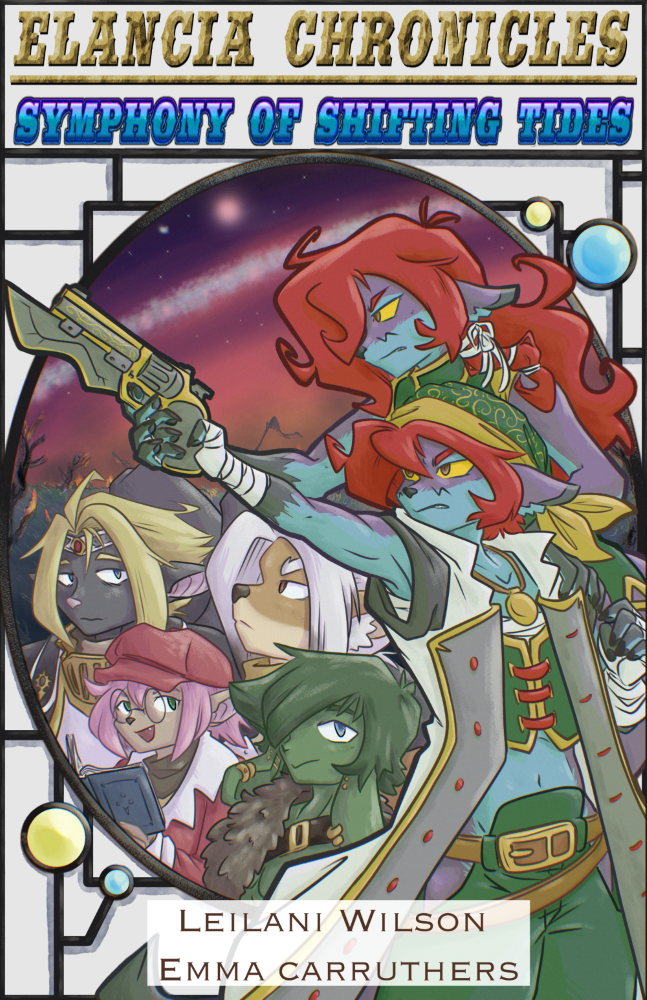
Symphony of Shifting Tides
Elancia Chronicles
Leilani Wilson & Emma Carruthers
Transcendent Fiction Publishing
June 2025
Print Edition A$40.00
Ebook Edition $3.99
Despite being nominated for a Cóyotl Award, Symphony of Shifting Tides slid under my radar when its first edition, published by now-defunct Goal Publications, came out in 2019. It was re-released in an extensively revised version last year by Australia’s Transcendent Fiction Publishing, now credited to two authors—the original was credited only to Wilson. Goal apparently demanded changes to make the book more appropriate for YA audiences; this iteration definitely seems aimed at adults, even if many of the characters are relatively young.
There are many characters, places, and ideas in Shifting Tides, but the nominal protagonist is a “fox-kin” named Verse, an apathetic, amoral and extremely prickly ne’er-do-well making a living as a pirate at the story’s opening. Verse and their partner in crime, rabbit-kin Xan, live in the world of Elancia, which is largely at war with itself. Different political and religious factions fight over gods—gods who are real, and occasionally walk the earth—and dwindling resources as the oceans slowly die a strange, magical death.
Xan and Verse find themselves caught up in a war between two countries, Dascillia and Celestion, with assassins inexplicably targeting them. As they flee, they accumulate traveling companions who come and go at various points: Cecelia the magic-using and extremely eccentric young bat-kin, Karina the giant dog-kin soldier, and more, from generals to more assassins to a troupe of traveling performers. (Note that giant in Karina’s case is around seven feet tall—not giant to Arilin’s IC standards, but pretty tall by most people’s.)
Layered on top of all this intrigue is, well, more intrigue. The only place Verse feels safe is in dreams—and in those dreams, Verse is definitively female, comforted by her dreamworld sister Lyrikos. In the waking world, Verse is male but rather androgynous, and some of the few times “he” seems happy involves finding beautiful dresses. Observant readers will guess that Verse is trans very early on, but Verse hasn’t figured that out by the story’s end.
As the novel progresses, we learn Verse isn’t the only one who has secrets, or isn’t what they seem. Xan has his secrets, as does Cecelia, as does Karina, as does Basil the bat-kin night—as does Lyrikos, who, it becomes increasingly clear, is not a figment of Verse’s imagination. Verse has holes in her memory, and Lyrikos may be responsible for them—but even that is more complicated than it might appear at first glance.
If I had to sum up this novel in one sentence it would be: this is a lot, y’all. This is the first volume of a projected four-volume series, and it’s over 200,000 words on its own. We’re not even getting into how Elancia Chronicles is a series of concept albums in addition to novels, drawing inspiration from JRPGs. (I presume the cover design is meant to evoke that look.)
There’s a lot to admire here, from the extensive and imaginative world-building to the themes of queer self-discovery and neurodivergence to the literary style. The milieu has the texture and trappings of fantasy, but there are glimmers of not just technology but futuristic technology here and there; both humans and non-anthropomorphic animals exist in the world. Is this actually far in Earth’s future, on this planet or a distant one? That may not be a question that’s ever answered, but this is the kind of story that makes you ask the question, and I love that. The adventure aspects are thrilling, and nearly all the characters, even relatively minor ones, feel complex and well-developed.
I have a few nitpicks, to be sure, some of which fall into the “things editors should probably tell you not to do” bucket. Many characters, including Verse, have strong accents, and I wished the text had followed the oft-repeated advice to establish that early with a few examples and then stop rendering it phonetically in a heavy-handed fashion. If you do it right, readers are hearing the voice in their heads without having to decipher the text. And, while this might be a choice unique to the ebook edition, a quirky monospaced typeface gets used for extensive stretches of text. (Please don’t.) Also, as crazy as it is to say about a novel this long, the last act feels rushed: another editing pass which shortened the first half—even at the cost of some darling-killing—could have opened up space.
The most striking thing about Shifting Tides, though, is that it was gripping enough to keep me reading despite Verse being such a difficult character to like. She actively resists being likable; she’s emotionally detached and all too frequently openly hostile to those trying to offer help. Yet despite that, I still rooted for her—while at the same time rooting for someone to successfully navigate her defenses and get through to her. I’ve never had the experience before of identifying with someone I so much wanted to slap the shit out of. This is an intriguing story with an exquisitely flawed, compelling lead.
Of note: if you’re an ebook buyer, this is a particular bargain at only $4. (I don’t know what the paperback price will be from North American and European distributors; as of this writing, $40 AUD is about $28 USD.)