The intriguing sequel to “Dissolution” continues the story of villain Starshade and the former hero now known as Geode. And an entirely new character, neither hero nor villain, enters the scene…
Review: Crystallization
Arilin Thorferra
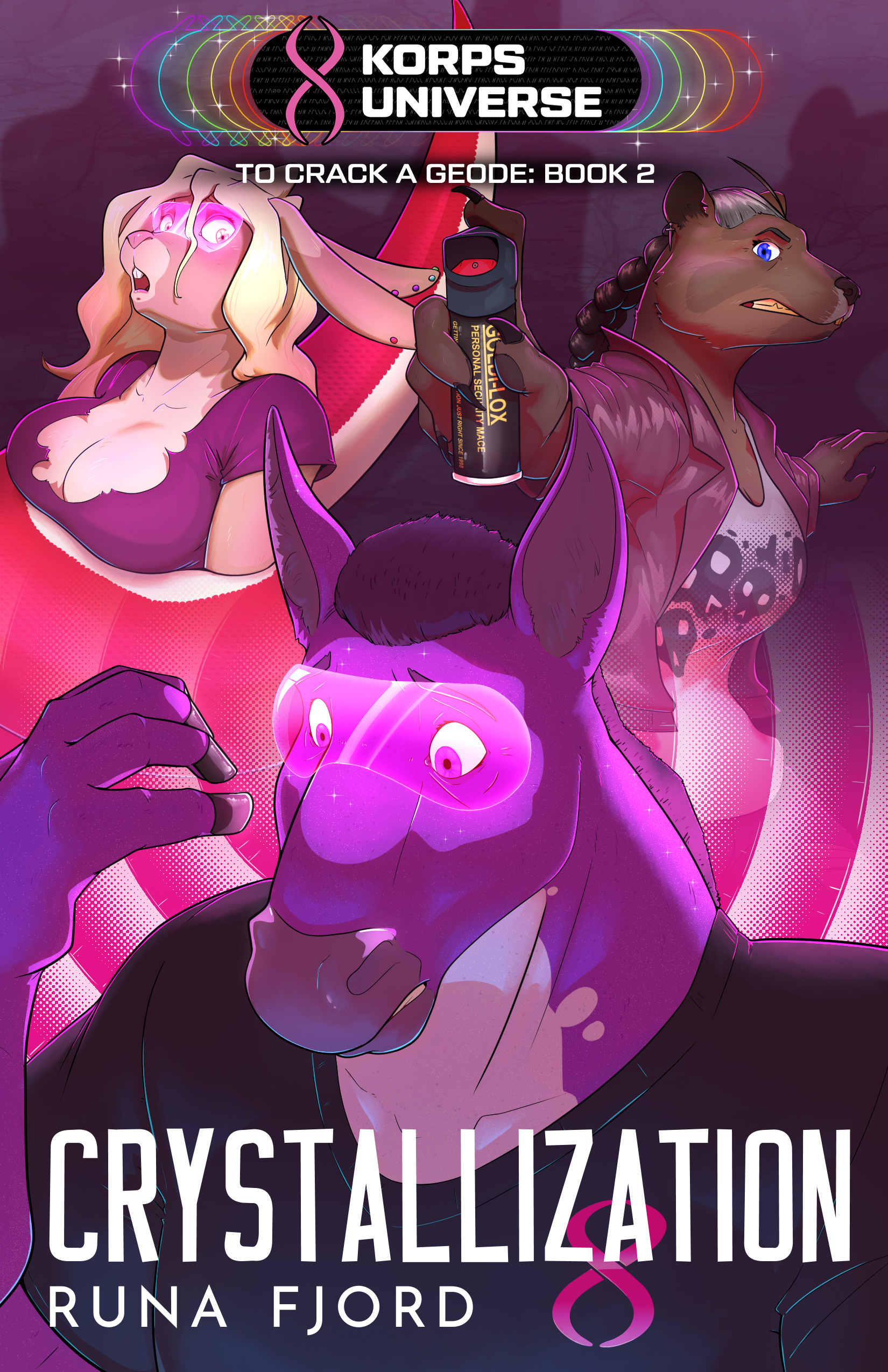
Crystallization
To Crack a Geode: Book 2
Runa Fjord
FurPlanet Productions
December 2025
Print Edition $19.95
Ebook Edition $9.95 (DRM-free)
FurPlanet has been on a tear with the Korps Universe novels, furry’s first shared universe franchise in many years (the only other one that comes to mind is MU Press’s The Furkindred from 1991). Now, the first “second issue” of a Korps novel has arrived: Crystallization is the direct sequel to Dissolution, the story of Korps villain Starshade’s encounter with a major TPA hero and the fallout from it.
The rest of this review contains spoilers for Dissolution.
While Dissolution kept a tight focus on its two protagonists, Crystallization begins with them separated. Starshade the rabbit was nearly killed at the end of the first book, and her body is being rebuilt by the Korps’ advanced medical systems (personified by the synthetic vixen Nurse O, who has a bigger—and more unusual—part in this story than she has in others). Meanwhile, the Percheron is trying to adjust to her new life, guided by people who were, a short time ago, her mortal enemies.
But, the book starts by adding a third major character to the mix: Jennifer Delver, who’s not part of the Korps or any Hero group. She’s a health inspector. In the opening sequence, a mysterious curse is passed from a dying elephant shrew to her, a mark that impels Heroes to hunt her and foretells of a “Master” who will bind her. This sets the nutria on a quest to figure out what the hell she’s been cursed with—and protect herself from those with superpowers on the way. While I found her introduction a little rushed, her story overall is terrific, and a perspective on the world—neither hero nor villain—that we haven’t had before. Jennifer is not a meek bureaucrat type by any stretch; she’s a hell of a tough, determined woman, and you can’t help but wonder where her story’s going to lead.
Starshade and the rechristened Geode, meanwhile, are at the underground Korps base in Texas. Most of Geode’s story in Crystallizatiion is about having her entire worldview upended. Does she fully trust the Korps? Even if she does, can she adjust to her life there? She meets not just Volta and Ellen but Maddy the sheep-bear and Mabel the cougar (protagonists of Change of Heart and The Magician, respectively), as well as a few characters who are at least entirely new to me, like Dawn the dik-dik, a cheerful, five foot tall menace. The biggest, most terrifying adjustment Geode has to make is to the idea that she’s surrounded by people who genuinely care about her well-being. As ROSE the AI puts it to her, “We’re villains. That means we take care of each other,” to which Geode wryly notes, “That sounds so backwards.”
Starshade’s story begins as one of recovering from her near-death experience, then moves into her tentatively exploring a relationship with an unexpected villain—the base commander, Celia, a giant lamia. As that progresses, the story definitely earns its adults-only rating. Even the kinkiest bits with Starshade keep the rabbit’s charming humor, as well her knack for getting in over her head.
Jennifer’s story overall is tense and propulsive, with a lot of action and building mystery. If Crystallization has a flaw, it’s that Geode and Starshade’s sections don’t have the same level of propulsiveness. As with Realignment, moving the action onto the Korps base shifts the dramatic gears from “superpowered action” to “hangin’ with the villains.” They’re good (and spicy) hangs, and both horse and bunny face serious stakes in their own way, but Jennifer’s stakes are literally life and death. We reach the novel’s end with the nutria’s tale still lacking obvious connection to the other two stories; I would have liked, if not an aha moment, at least a hmm moment.
So am I looking forward to the next issue, as the novel cheekily dubs it? Without a doubt. The Korps’ secret weapon is that its “villains” are, by and large, extremely likable. You want good things to happen to them—and you want to keep reading to see what happens next.