A lot of writers bristle at the idea of planning out their stories beforehand, but a little structure goes a long way. Here’s why.
Planning stories
Arilin Thorferra
A lot of writers—especially aspiring ones, but also well-established ones—don’t like talking about planning and especially don’t like talking about story structure. I get that, but let’s talk about why it’s important, using myself as a bad example (hi!): it will, almost without exception, make your story better.
In general, I start stories, no matter how short or long, with three touchstones borrowed from the late editor/publisher Algis Budrys:
- a character
- in a specific context (milieu and/or situation)
- with a problem
The character, in this case, is the story’s protagonist. In all but the rarest cases, I want another character for the first to bounce off of. This is not the antagonist, but a “catalyst,” someone who challenges the protagonist’s thinking in some way. (Most stories have antagonists, too, but not all: there’s no antagonist in “Drinking Game” or “Regulars”, but there’s a catalyst character in both.)
By the time you get to novella length like Goddess or Big Trouble, though, you need more structure: a plot with rising tension/action, an arc for major characters. You don’t need a capital-O Outline, but it helps to at least have major “turning points” in mind. This is what I learned as the “Plot W”:
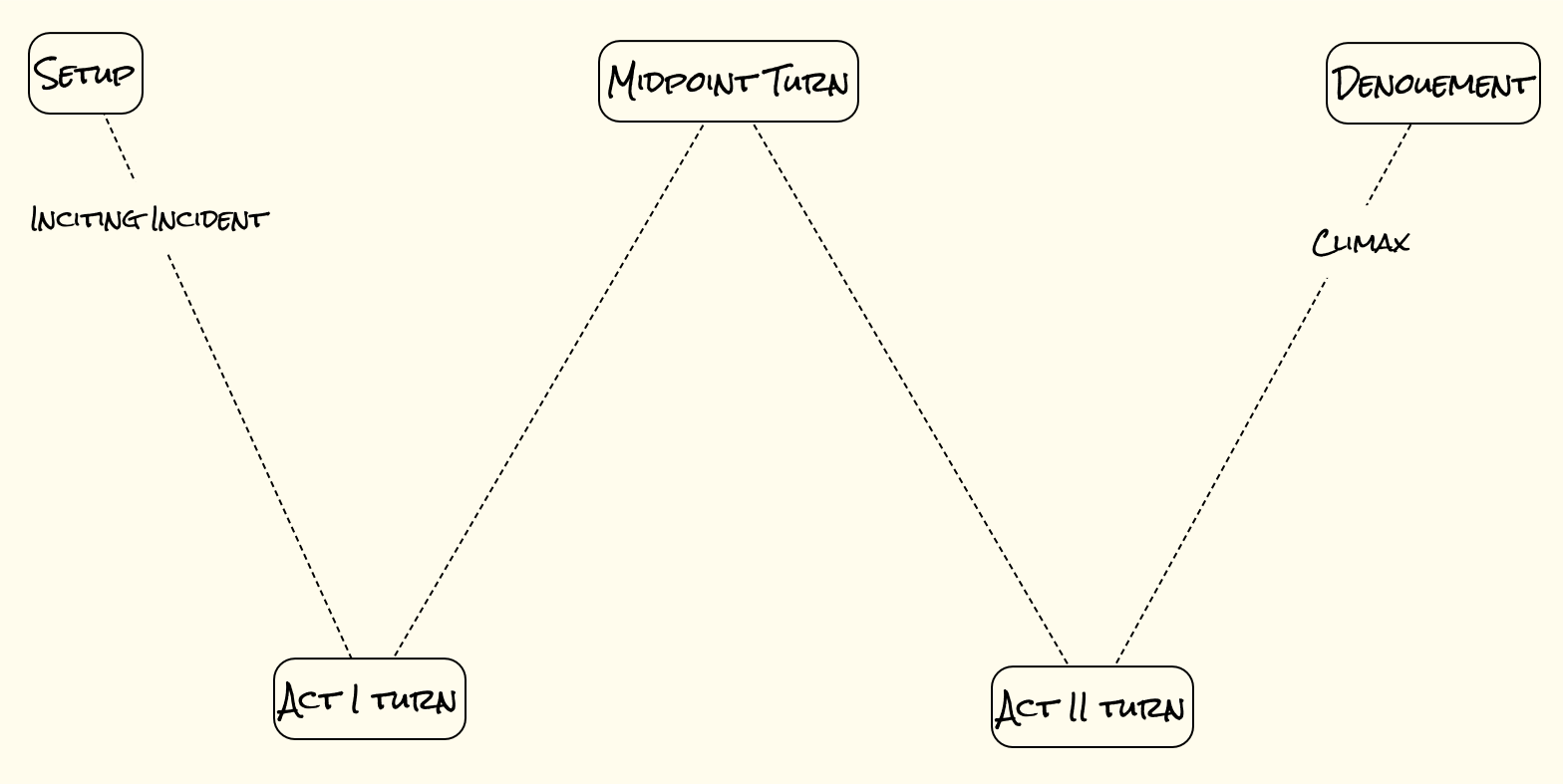
If you’re a writing nerd, you might recognize this as a cousin of Dan Wells’s Seven-Point Story Structure. An inciting incident kicks your protagonist out of their status quo. You have major turning points, try/fail cycles, stakes that matter to the characters (and the reader), and a new status quo at the end.
So here’s why some writers don’t like talking about this sort of stuff: they see it as a prescriptive “formula” that locks them into some kind of paint-by-numbers framework. By gum, they’re not going to fall into the trap of writing anything like an action thriller that (checks notes) made a billion dollars at the box office. That would sure suck!
Seriously, there is overly prescriptive advice out there, like Blake Snyder’s (in)famous Save the Cat! formula. Although understanding why Save the Cat! works—and it does—will still make you a better writer. But tools like the Plot W or the Seven-Point Structure are descriptive, tools that help you build a solid story. Understanding story structure doesn’t force you into a paint-by-numbers framework any more than understanding sentence structure does.
Okay. Do you know the terms “plotters” and “pantsers”? Plotters are obsessive outliners, and pantsers hate outlining and write “by the seat of their pants”. At least, that’s the stereotype. In practice, nearly all pantsers plan whether or not they recognize it, nearly all plotters write without a net occasionally whether or not they recognize it, and most writers—like me—fall between the two extremes.
Some pantsers intuitively lock in on a structure. A couple of times I managed that with novellas, but for years I couldn’t write something novel-length to save my life. What got me over the hump was a residential writing workshop, the Ad Astra Novel Architects. What that taught me I needed was, in a real sense, more structure. A sense not just of the turning points and the big set pieces I had in my head, but of arcs for all the major characters. Even if it wasn’t a conventional outline, the plan needed to show me where I was missing crucial scenes.
How did it do that? If you’re using the Plot W—which I learned about at that workshop—you fill in scenes along each leg like bullet points. (In The Turning, the first few scenes along the first leg read “Moira & Diana”, “Moira & Hazel,” “Celestial starts tracking”, “Moira & Stetson”, “Celestial’s first failed intervention”.) These don’t have to be complete, they may change as you start writing, yadda yadda yadda—but you want a roughly equal number of scenes along each leg, say nine or ten. What you usually find when you start plotting is that you have a lot on the first leg, a little on the second, and maybe one or two set pieces on the third and fourth. It’s a great visual aid to show you the parts of your story you haven’t thought enough about yet.
Saida & Autumn, the serial that opened my Patreon, was roughly plotted ahead of time. I left room for lots of “discovery writing” along the way, but I knew I was doing a kind of story I’d never done before: a romance with dual protagonists, where Autumn is Saida’s catalyst character and vice versa. Moira was rather infamously under-plotted at first, but I got much more rigorous when I realized I was actually writing a novel rather than a few vignettes.
But by the time I started doing novellas like Big Trouble and Gates here, I got confident about less planning—I’d started to internalize it. Big Trouble needed the mystery worked out ahead of time, of course, but a lot of the details were ad hoc. And Hurricane (currently only on Fur Affinity and Patreon) was…well, as I was finishing it I thought it was half-baked. But I’d developed enough of a sense for plot structure that I managed a decent job without ever finishing a Plot W for it. (I’ve reread it since and think it holds together better than I’d thought.)
Okay, so now we get to my 2025/2026 Patreon serial, Mus Numena.
I thought it would be more novella than novel: a word count of 20–30K, not the 100K it ended at. So, hey, I just pantsed it, and even when it was quickly clear it was a bigger story than I’d thought, I kept doing it. I thought it’d be fine! I had an ending in mind from fairly early on, even if I didn’t know how I’d get there.
But, well, was it fine? Let’s go back to those three touchstones:
- a character
- in a context
- with a problem
I have my protagonist, Ted Bishop, and I have a context—a situation and milieu—for him at the start: our world, Silicon Valley, middle-aged IT dude, well-off but not rich, and recently having ended a long-term relationship.
But what’s Ted’s problem? He had a breakup, but it didn’t really play into the story much as written. He works for a tech company that’s shit, but that’s not a problem for him at the story’s start, at least. So that’s probably not it, either.
Hmm. Aurora, a genetically-engineered mouse woman, asks him for help! That kicks off the real plot! So that’s his problem, right? Well, no: that’s the story’s inciting incident.
Russell’s problem in Goddess is his rigid life outlook. Saida’s problem in Saida & Autumn is that she has PTSD from the experience that gave her a reincarnation ability, turning it from something amazing to something she hates. Autumn’s problems involve her family’s reactions to her being transgender (and giant), and the looming uncertainty most college students face as graduation approaches. These all give the characters their own arcs—their problems are resolved by the events in the story’s overall plot.
This, then, points at the heart of the muddle: Ted doesn’t have much of an arc. Actually, with the possible exception of Aurora, nobody has that much of one. So while I had a destination in mind for the overall plot, the journey ended up a meandering ramble. You know what would have helped me a lot here?
∗cue Jaws music, with a Plot W diagram slowly rising to the surface∗
In fact, I should have had a character arc defined for several major characters, figured out how to get the real villains involved earlier, had more satisfying ends for a few of them, given a few side characters more do to, and probably come up with a scene or two that would make readers cry. I should have planned.
To be clear, I genuinely like a lot of Mus Numena. I like the characters. A theoretical future rewrite would keep many of the same set pieces and plot turns. But a lot of the problems I had writing this one came from getting too far on the pantser side of the divide for my own good this time around.
Okay, so: if you, imagined reader of this, want to apply this lesson to your stories, how can you? First and foremost, don’t be afraid of structure. When you learn about story theory, it gives you a lens to examine your ideas with, fill them out, make them stronger.
- Where’s your protagonist at the story’s start and where is she at the end? If you nail this, you’ve started both the overall plot arc and her character arc.
- What’s the antagonist’s goal, and how is it in conflict with the protagonist’s goal? The central tension in your story’s overall plot arc comes from these two goals being mutually exclusive.
- Who’s the catalyst character, and how does her interaction with the main character play out? The central tension in your story’s theme comes from this relationship.
- What’s the consequence if the protagonist doesn’t achieve their goal? What are the stakes—for both the overall plot and the protagonist personally? What’s the cost of achieving that goal?
If you’re used to pantsing everything, answering these questions before you start writing—let alone working out a Plot W or a Seven-Point Structure—almost certainly sounds horrible and/or terrifying. And, you may be positive that you, specifically, just don’t need it: you’ve done great before without it. You may not be wrong! Like I said, sometimes people naturally hit on a solid structure. I’ve done it myself!
Sometimes.
But when I started thinking about structure, I undeniably started doing better. Novellas stopped being hit-or-miss; novels started being possible. Even my shortest stories improved.
And, yes, I started internalizing a lot of this, and stopped having to do quite as much planning. But, as I just painfully relearned, Mus Numena would have been better if it had been constructed more thoughtfully. Even as long as I’ve been doing this—since the invention of the electric light bulb, more or less—I can’t consistently naturally fall into a great structure spread over a hundred thousand words. Maybe you can, but if you’re struggling, try learning a bit more about structure. And if you’re sure you don’t need it, learn enough to evaluate one of your older works through a structural lens. You might be surprised at what you see.